Hot Water System Options

Hot Water System Options

The hot water system supplies the bathroom and kitchen with heated water for daily use.
This page outlines the available heater types, their advantages, installation considerations, and how each option integrates with the overall plumbing layout.
The garage is the leading candidate for installation due to its ventilation, service access, and proximity to the bathroom.


1. System Requirements

The hot water system must supply heated water to the following fixtures:

  • Bathroom sink
  • Shower
  • Washer/Dryer Combo (if supported)
  • Kitchen sink

PEX hot water lines will run from the heater location (likely the garage) upward into the bathroom and forward to the kitchen.


2. Tankless Propane Water Heater

A tankless propane heater is one of the most common solutions for RV and trailer builds.
It provides unlimited hot water as long as propane and water flow are available.

Pros

  • Unlimited hot water
  • Fast recovery time
  • Compact footprint
  • Low electrical draw (mostly for ignition and controls)
  • Ideal for garage installation with proper venting

Cons

  • Requires propane supply and regulator
  • Needs exterior venting
  • Minimum flow rate required to activate burner

Best For

Full‑time or frequent use, long showers, and multi‑fixture hot water demand.


3. Electric Tankless Water Heater

Electric tankless heaters provide on‑demand hot water without propane, but they require significant electrical capacity.

Pros

  • No propane required
  • Compact and simple installation
  • No combustion gases or venting

Cons

  • Very high electrical demand (often 40–60 amps)
  • Not ideal for off‑grid or limited‑power setups
  • May require electrical upgrades

Best For

Shore‑power use or locations with strong electrical service.


4. Small Electric Tank Water Heater (4–6 Gallons)

A compact electric tank heater stores a small amount of hot water and reheats as needed.
This is a simple and reliable option for moderate hot water use.

Pros

  • Low electrical draw compared to tankless
  • Stable water temperature
  • Easy installation
  • No propane or venting required

Cons

  • Limited hot water capacity
  • Recovery time required between uses
  • Not ideal for long showers

Best For

Light to moderate hot water use, shore‑power environments, and simple installations.


5. Marine/Hybrid 12V + 120V Water Heater

Marine water heaters can run on 120V AC or engine coolant loops.
In a trailer build, only the electric mode is used, but they offer excellent insulation and recovery.

Pros

  • Highly insulated and efficient
  • Dual‑power capability (12V assist on some models)
  • Reliable and long‑lasting

Cons

  • More expensive than RV heaters
  • Larger footprint
  • Not tankless — limited capacity

Best For

Users who want a premium, efficient, long‑life hot water solution.


6. Recommended Installation Location: Garage

The garage is the preferred location for the hot water heater due to:

  • Ventilation (especially for propane tankless)
  • Service access from both inside and outside
  • Proximity to bathroom fixtures
  • Space for mounting and routing PEX lines
  • Ability to isolate heat and noise from living areas

PEX lines will run upward into the bathroom and forward to the kitchen, creating a clean and centralized plumbing layout.


7. Hot Water Routing Plan

Regardless of heater type, the hot water distribution will follow this path:

  • Heater (garage)
  • Bathroom sink
  • Shower
  • Washer/Dryer Combo
  • Kitchen sink

This routing minimizes pipe length and ensures fast hot water delivery to the bathroom, which is the highest‑use zone.


8. System Summary

The hot water system is a critical part of the trailer’s plumbing design.
Tankless propane heaters offer unlimited hot water and are ideal for garage installation,
while electric tank or hybrid heaters provide simpler, low‑maintenance alternatives.
All options integrate cleanly with the bathroom‑centered plumbing layout and supply both the bathroom and kitchen.

As the build progresses, this page will be updated with the final heater selection, mounting details, and installation notes.
Design Applications

What Is a Floor Plan in Designing?

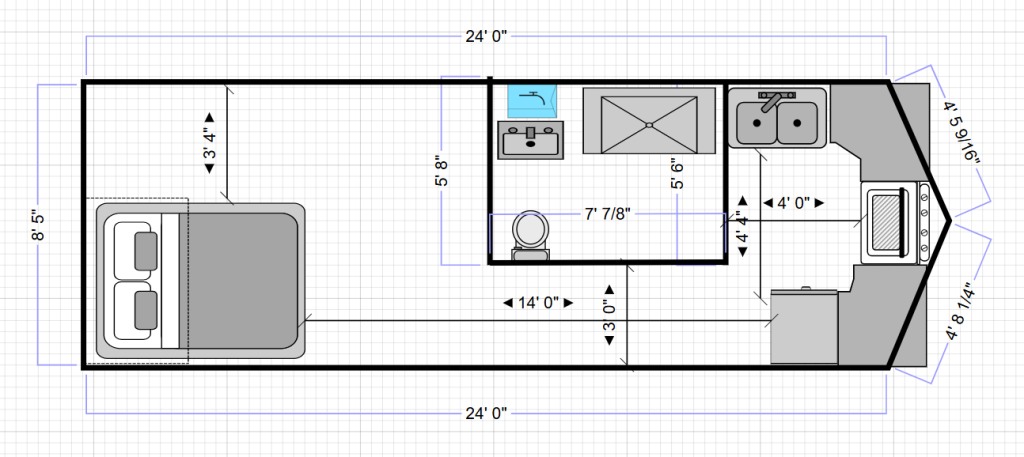
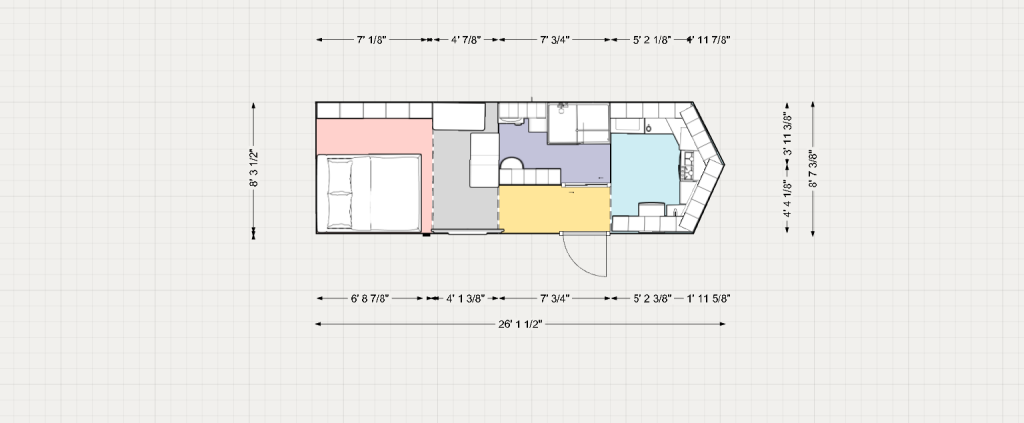
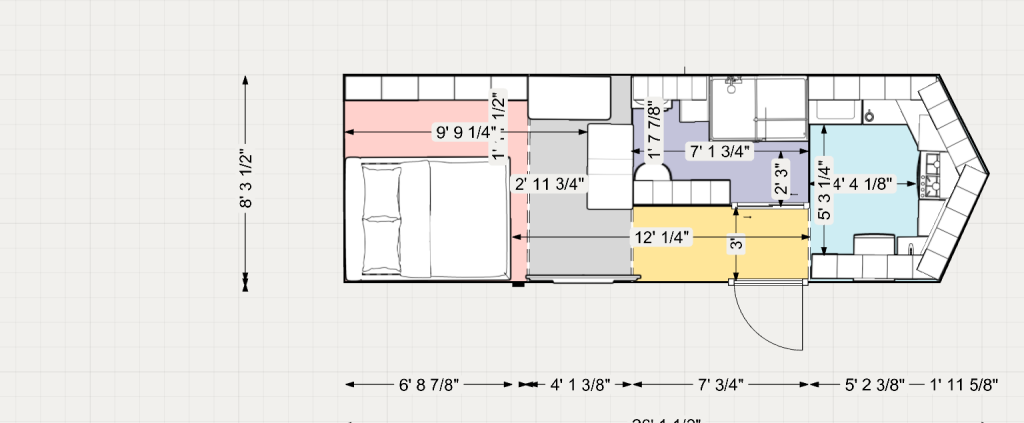
A floor plan is a scaled diagram of a room or building viewed from above. It illustrates the horizontal relationships of interior spaces, walls, and features at a single level of a structure. Floor plans are typically drawn in orthographic projection and usually represent the layout as if viewed from approximately 4 feet (1.2 m) above the finished floor.

The level of detail in a floor plan depends on the design phase. Early schematic plans may show only major spatial divisions and rough square footages, while construction‑ready plans include wall types, dimensions, fixtures, finishes, and electrical symbols. Floor plans may also include notes, material callouts, and renderings depending on the intended use.

Applications I Use for Floor Plan & Design Work

Layout

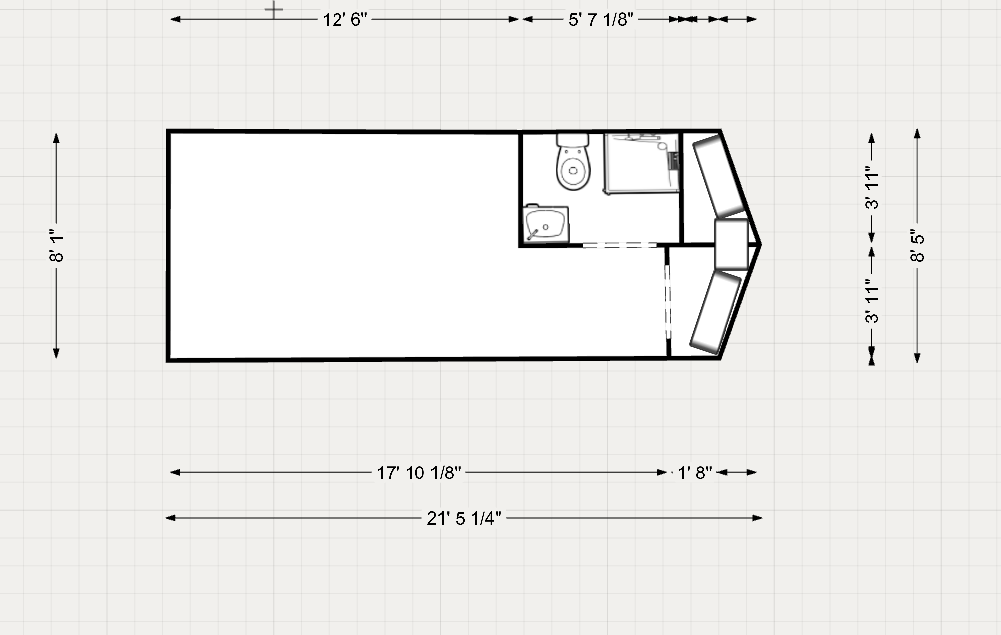
Your image shows:

  • A V‑shaped front layout for water tanks
  • A bathroom zone directly behind it
  • Shower on one side
  • Toilet on the opposite side
  • Tank depth around 3’11”
  • Total front section tank depth 8’5″
  • Another tank 3’11” behind the bathroom

This is perfectly aligned with your trailer’s:

  • 8’5″ V‑nose width
  • 18″ V‑nose depth
  • 4’5″ angled side walls
  • 8’1″ finished interior width
  • 21’2″ total interior length

Your drawing is essentially a scaled architectural version of your trailer’s front 8–9 feet.


Working interior & axes

Working interior & axes

  • Finished width: 97″ (X = 0″ driver wall → 97″ passenger wall)
  • Total length (with V): 254″ (Y = 0″ nose point → 254″ rear)
  • Rectangular box starts: Y ≈ 18″

1. Front bench / tank cabinet (under the “seating” concept)

This is your front wrap cabinet that visually acts like a bench and structurally hides the three tanks.

Cabinet footprint:

  • X = 20″ → 77″
  • Y = 10″ → 60″

That gives:

  • Room for the V‑nose angle at the very front
  • Depth for tanks + framing + access
  • A “bench” feel along the front and slightly back into the rectangular section

2. Tank positions inside that cabinet

Using:

  • 50 gal fresh: 22.25″ (X) × 14.25″ (Y)
  • 30 gal grey: 17.5″ (X) × 12″ (Y) each

All three centered left/right within the cabinet, left → right:

Left grey (30 gal):

  • X = 20″ → 37.5″
  • Y = 24″ → 36″

Fresh (50 gal):

  • X = 37.5″ → 59.75″
  • Y = 24″ → 38.25″

Right grey (30 gal):

  • X = 59.75″ → 77.25″
  • Y = 24″ → 36″

All three sit fully inside the front bench/cabinet zone (X 20–77, Y 10–60).

3. Shower (driver‑side, just aft of tank bench)

To echo that render—shower on one side, toilet on the other, bench/tanks in front—we’ll keep the shower slightly driver‑side, just behind the tank cabinet.

Assuming 36″ wide × 24″ deep:

  • X = 24″ → 60″
  • Y = 60″ → 84″

That:

  • Keeps it aligned with the tank cabinet
  • Leaves a clear passenger‑side path to the toilet
  • Gives you a nice “front bathroom zone” feel

4. Nature’s Head toilet (passenger side)

Planning box: 19″ wide × 21″ deep

Place it on the passenger side, roughly opposite the shower, with some space between toilet and front bench.

  • X = 72″ → 91″
  • Y = 60″ → 81″

So:

  • You walk into the front area
  • Bench/tank cabinet is visually ahead/angled
  • Shower is front‑left (driver side)
  • Toilet is front‑right (passenger side)

5. Quick copy block

Front bench / tank cabinet:

  • X = 20″ → 77″
  • Y = 10″ → 60″

Left grey tank (30 gal):

  • X = 20″ → 37.5″
  • Y = 24″ → 36″

Fresh tank (50 gal):

  • X = 37.5″ → 59.75″
  • Y = 24″ → 38.25″

Right grey tank (30 gal):

  • X = 59.75″ → 77.25″
  • Y = 24″ → 36″

Shower (36″ × 24″, driver side):

  • X = 24″ → 60″
  • Y = 60″ → 84″

Nature’s Head toilet (passenger side):

  • X = 72″ → 91″
  • Y = 60″ → 81″

Finished interior dimension spec – for planning & layout

📐 WORKING INTERIOR SPACE

Rectangular Interior (Finished After Front/Back Wall Build‑Up)

  • Length: 19′ 8″ (This is the 20′ interior minus 2″ front wall and 2″ back wall)
  • Width: 8′ 1″ (97″) (This already includes your 2″ per‑side wall build‑up — no further subtraction)

V‑Nose Extension

  • Centerline depth added by V‑nose: 18″
  • Side wall length from the 20′ mark to the point: 4′ 5″
  • Base width of V (same as trailer width): 8′ 1″ (97″)

Total Finished Interior Length (Centerline)

19′8″+18″=21′2″

➡️ Total finished interior length including V‑nose: \\21′ 2″ (254″)\\**

Finished Interior Height

84″−4″ (floor)−2.5″ (ceiling)=77.5″

➡️ Finished height: 77.5″ (6′ 5.5″)

📏 SUMMARY BLOCK

Finished Interior Dimensions (V‑Nose Trailer):

  • Rectangular Length: 19′ 8″
  • V‑Nose Depth: 18″
  • Total Length (Centerline): 21′ 2″
  • Finished Width: 8′ 1″ (97″)
  • Finished Height: 77.5″ (6′ 5.5″)

Build‑Up Used:

  • Floor: 4″
  • Ceiling: 2.5″
  • Front Wall: 2″
  • Back Wall: 2″
  • Side Walls: 2″ per side (already included in the 8’1″ width)

The Trailer

8.5×20 Charcoal Enclosed Trailer with Blackout Package (2) 5200lb Axles Storage


8.5×20 Charcoal Enclosed Trailer with Blackout Package (2) 5200lb Axles Storage

8.5×20 Charcoal Enclosed Trailer with Blackout Package (2) 5200lb Axles

Features:

  • Charcoal Screwed Exterior – Durable aluminum exterior with a sleek charcoal finish provides a professional appearance while resisting corrosion, fading, and daily wear.
  • Spring-Assisted Loading Ramp – Full-width rear ramp allows smooth loading and unloading of cargo or equipment, with spring assist for controlled, effortless operation.
  • 7′ Interior Height – Comfortable interior clearance allows easy movement, loading, and organization of cargo.
  • (2) Greaseable 5,200 lb Axles – Tandem heavy-duty axles with greaseable hubs provide reliable towing, increased load capacity, and long-lasting durability.
  • 24″ Black ATP Stone Guard – Aluminum tread plate protects the front of the trailer from rock chips, debris, and road wear, extending exterior life.
  • Includes Safety Chains, Jack, and Coupler – Essential towing hardware ensures safe and secure connection to your vehicle.
  • Built-In Side Vents – Integrated vents promote airflow, reduce heat and moisture buildup, and help protect cargo inside the trailer.
  • Heavy-Duty Plywood Walls and Floor – Reinforced plywood interior adds structural strength and supports heavy cargo loads while resisting wear.
  • 15″ Wheels and Tires – Durable wheels paired with highway-rated tires ensure stable handling, long-lasting performance, and safe towing.
  • (4) D-Rings Built into Floor – Recessed steel D-rings provide secure tie-down points for safely transporting equipment or cargo.
  • 36” Passenger Entry Door – Convenient side door allows easy entry without opening the rear ramp, improving usability and access.
  • Brands May Vary Based on Stock – Trailer specifications remain similar even if certain components or brands differ based on availability.

Brands may vary based on stock. Similar specs are used across all brands.

MoreInformation

Manufacturer: SLE Enclosed Trailers
MPN: 8.5X20CHARCOALBLACK
Condition New
Shipping Options Store Pickup / Delivery Only Call For Price
Load Capacity 6490lbs
Trailer Interior Width 8′ 5
Wheel Size 15”
Trailer Interior Length 20 ft
Floor Type Plywood Flooring
Hitch Type Bumper Pull
Axle Size two – 5,200lb
AC / Heat No
Roll Out Awning No
Interior Height 7′
Exterior Metal Screwed
Flood Lights No
Extended Tongue No
Warranty 1 Year Limited Warranty