Save a Drop P3 Water Flow Meter – Fresh Water Fill Monitoring

Save a Drop P3 Water Flow Meter – Fresh Water Fill Monitoring

As part of planning the fresh water system for this cargo trailer conversion, I wanted a simple way to
monitor how much water is going into the tanks during fills.
A small inline flow meter on the hose is an easy, low‑tech way to track gallons used and avoid overfilling.

One product I’m considering for this purpose is:


Save a Drop P3 Blue Water Flow Meter – Measure Gallon Usage from an Outdoor Garden Hose


Product Overview

The Save a Drop P3 is a compact, inline water flow meter that attaches to a standard garden hose.
It measures the total volume of water passing through and displays usage in gallons, making it useful for
filling RV or trailer fresh water tanks, portable containers, or even just tracking water consumption.

  • Type: Inline water flow meter
  • Connection: Standard garden hose
  • Display: Digital readout of gallons used
  • Use Case: Monitoring tank fills and conserving water

Why This Is Useful for the Build

When filling fresh water tanks, it’s easy to lose track of how much water has gone in—especially when filling from
portable containers or non‑metered sources.
A small flow meter like this provides:

  • Overfill awareness: Know how many gallons have gone into the tank before it reaches capacity.
  • Repeatable fills: Easy to track partial fills (e.g., “add 10 gallons” instead of “fill until it overflows”).
  • Water usage insight: Helps understand how quickly water is consumed during trips.
  • Portable and flexible: Can be used on any hose, not permanently installed.

How It Fits Into the Fresh Water Workflow

In practice, this meter would be attached inline on the hose used to fill the fresh water tank(s).
Before starting a fill, the meter can be reset to zero, and the display will show the total gallons added during that session.

  • Attach meter between spigot and hose, or hose and tank fill.
  • Reset meter before each fill.
  • Monitor gallons as the tank fills to avoid overfilling.
  • Optionally log usage to better understand daily water consumption.

This page serves as a reference for a simple, portable tool that can make tank filling more controlled and predictable,
especially when working with multiple tanks or off‑grid water sources.

Bathroom Plumbing Concept – Raised Floor With Integrated Sump Pump System

Bathroom Plumbing Concept – Raised Floor With Integrated Sump Pump System

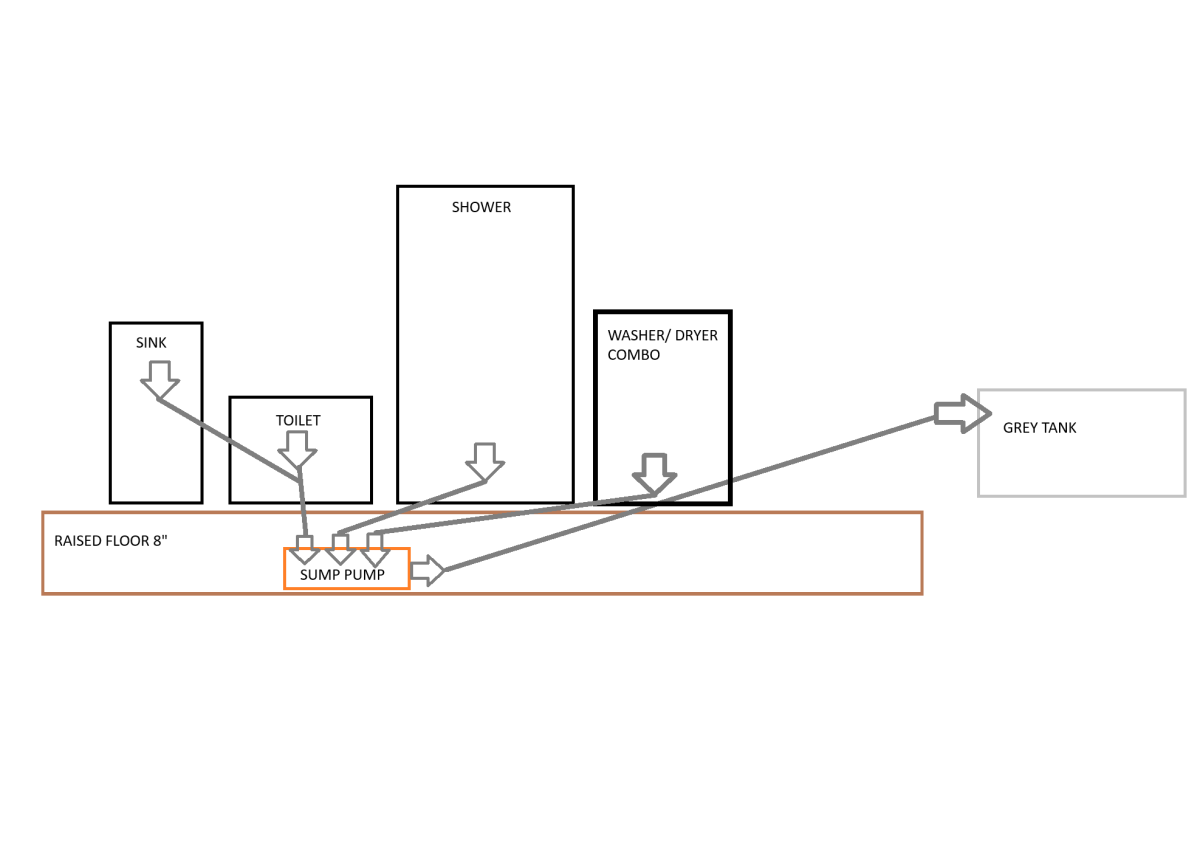
This post documents the current concept for how the bathroom plumbing will function inside the cargo trailer conversion.
The bathroom floor will be raised approximately 8 inches, creating a dedicated plumbing cavity beneath the finished floor.
All bathroom drains—including the shower, toilet urine separator, and bathroom sink—will run inside this raised floor space.
Access panels will be built into the floor structure to allow maintenance of lines, fittings, and the sump pump.


System Overview

The raised floor provides enough vertical space to route all plumbing internally without mounting any tanks or lines under the trailer.
A 12V sump pump box will collect wastewater from the bathroom fixtures and pump it into the interior gray tank.
This approach keeps all plumbing inside the insulated envelope of the trailer for freeze protection and easier serviceability.


Plumbing Flow Diagram


                 ┌───────────────────────────────┐
                 │            SINK               │
                 │  (Drain enters floor cavity)  │
                 └──────────────┬────────────────┘
                                │
                                ▼
                 ┌───────────────────────────────┐
                 │     COMPOSTING TOILET         │
                 │   (Urine Separator Outlet)    │
                 └──────────────┬────────────────┘
                                │
                                │  Sink + Urine Combined Drain
                                ▼
                 ┌───────────────────────────────┐
                 │           SHOWER              │
                 │ (Low-profile drain to sump)   │
                 └──────────────┬────────────────┘
                                │
                                ▼
                 ┌───────────────────────────────┐
                 │     12V SUMP PUMP BOX         │
                 │  - Collects all bathroom flow │
                 │  - Auto pump activation       │
                 └──────────────┬────────────────┘
                                │ Pressurized Output
                                ▼
                 ┌───────────────────────────────┐
                 │          CHECK VALVE          │
                 │ (Prevents backflow from tank) │
                 └──────────────┬────────────────┘
                                │
                                ▼
                 ┌───────────────────────────────┐
                 │         INTERIOR GRAY TANK     │
                 │  (Mounted inside trailer)      │
                 └───────────────────────────────┘


Key Design Details

  • Raised Floor (8″): Creates a protected plumbing chase for all bathroom drains and the sump pump.
  • Access Panels: Built into the raised floor for serviceability of the sump pump, fittings, and drain lines.
  • Toilet Elevation: The composting toilet will sit at least 1 foot above the sump pump to ensure reliable gravity flow.
  • Sink Drain Tie-In: The bathroom sink will tie into the urine line to flush and clean the line and provide enough liquid volume to activate the sump pump float switch.
  • Shower Drain: A low-profile drain routes directly into the sump pump box.
  • Check Valve Placement: Installed on the sump pump discharge line before the gray tank to prevent backflow.
  • Interior Gray Tank: All wastewater is pumped into an interior tank for freeze protection and easier maintenance.

Why This System Works Well for an Interior-Only Plumbing Layout

This design keeps all plumbing components inside the conditioned space of the trailer, eliminating the need for under‑floor tanks or exposed plumbing.
The sump pump allows the gray tank to be positioned higher than the shower pan or toilet outlet, giving full flexibility in tank placement.

  • No exterior tanks: Better freeze protection and no road debris exposure.
  • Flexible routing: Pumped discharge allows tank placement anywhere inside the trailer.
  • Serviceability: Access panels ensure all components can be reached without tearing up the floor.
  • Cleaner plumbing: Sink tie‑in keeps urine lines flushed and reduces odor risk.

This mock‑up represents the current direction for the bathroom plumbing system and will be refined as the layout and tank placement are finalized.

Updated Diagram – Urine Separator, Sink Drain, Sump Pump, and Gray Tank System

Updated Diagram – Urine Separator, Sink Drain, Sump Pump, and Gray Tank System

This diagram shows the updated plumbing layout for the bathroom: the composting toilet’s urine separator and the bathroom sink both drain into the sump pump box.
The sump pump then sends all liquids to the interior gray tank, with a check valve placed before the gray tank to prevent any backflow.
The toilet sits elevated above the sump pump by at least one foot, ensuring reliable gravity flow.


System Diagram (Top‑Down Flow)


                 ┌───────────────────────────────┐
                 │     COMPOSTING TOILET         │
                 │   (Urine Separator Outlet)    │
                 └──────────────┬────────────────┘
                                │
                                │  Gravity-fed Urine Line
                                ▼
                 ┌───────────────────────────────┐
                 │       BATHROOM SINK           │
                 │  (Drain Tied Into Urine Line) │
                 └──────────────┬────────────────┘
                                │
                                ▼
                 ┌───────────────────────────────┐
                 │   COMBINED DRAIN LINE (1")    │
                 │  Sink + Urine to Sump Pump    │
                 └──────────────┬────────────────┘
                                │
                                ▼
                 ┌───────────────────────────────┐
                 │     SUMP PUMP BOX (12V)       │
                 │  - Collects shower water      │
                 │  - Collects urine + sink      │
                 │  - Auto pump activation       │
                 └──────────────┬────────────────┘
                                │ Pressurized Output
                                ▼
                 ┌───────────────────────────────┐
                 │         CHECK VALVE           │
                 │  (Prevents backflow from tank)│
                 └──────────────┬────────────────┘
                                │
                                ▼
                 ┌───────────────────────────────┐
                 │       INTERIOR GRAY TANK      │
                 │  - Receives all pumped liquid │
                 └───────────────────────────────┘


Side‑View Height Relationship


   [Composting Toilet]
            │
            │  (Urine Line)
            ▼
   [Sink Drain Tie-In]
            │
            ▼
   (Combined Drain Line)
            │
            ▼
   [Raised Shower Platform]───────────────┐
            │                              │
            ▼                              │
      [Sump Pump Box]  <───────────────────┘
            │   (Pumps upward)
            ▼
      [Check Valve]
            │
            ▼
      [Interior Gray Tank]

This layout ensures the toilet and sink both drain by gravity into the sump pump, while the sump pump handles all elevation changes needed to reach the gray tank.


Why the Sink Tie‑In Helps

Tying the bathroom sink into the urine line provides several benefits:

  • Flushes the urine line with clean water every time the sink is used.
  • Prevents salt buildup or odor in the urine hose.
  • Adds enough liquid volume to reliably trigger the sump pump float switch.
  • Reduces plumbing complexity by combining two low‑flow drains into one line.

Why the Check Valve Belongs Before the Gray Tank

Placing the check valve on the pressurized discharge line (not the urine line) ensures:

  • No gray water can flow backward into the sump pump box.
  • No contamination risk for the toilet or sink drain lines.
  • The sump pump remains protected from tank pressure or sloshing.

This updated diagram reflects the final intended flow path for the bathroom plumbing system and will be used as part of the full interior‑only plumbing documentation.

Build Notes – Floor, Insulation, and Bathroom Plumbing

Build Notes & Lessons Learned – Floor, Insulation, and Bathroom Plumbing

As I continue refining the design for the cargo trailer conversion, I’m collecting important details that will influence how the trailer is ordered and how the interior systems are built.
These notes focus on floor structure, insulation planning, and bathroom plumbing considerations based on research and reference videos.


No Dovetail for a Level Interior Floor

For this build, a flat, level floor is essential. This means the trailer must be ordered with no dovetail.
A dovetail is the angled drop at the rear of many cargo trailers, designed for loading low vehicles.
While useful for ramps, it creates an uneven interior floor and complicates cabinetry, flooring, and bathroom layout.

Choosing a non-dovetail rear ensures:

  • A fully level floor from front to back
  • Simpler installation of flooring, insulation, and cabinetry
  • Better support for the raised shower platform and tank placement

Interior Doors Must Be Raised for Floor Insulation

If the trailer does not come factory-insulated, the interior floor will be built up with insulation and subfloor layers.
This adds approximately 1.5 inches of height to the finished floor.

To avoid clearance issues:

  • Interior doors (bathroom, bedroom, etc.) must be raised at least 1.5″ during installation.
  • Dealers should not install interior trim — trim should be left loose inside the trailer.

This prevents the door from dragging on the finished floor and allows trim to be installed after insulation and flooring are complete.


Backer Boards Before Insulation (Video Reference)

In this video (timestamp 2:15):

Cargo Trailer Conversion – Insulation Prep

The creator explains the purpose of installing backer boards before adding insulation.
These boards provide:

  • A solid mounting surface for walls and fixtures
  • Structural support for areas where screws cannot bite into foam
  • Better rigidity and long-term durability

This reinforces the plan to include backer boards in key areas before insulating the walls and ceiling.


Urine Separator Plumbing Into Sump Pump (Video Reference)

In this video (timestamp 27:50):

Cargo Trailer Bathroom Plumbing – Urine Separator & Sump Pump

The builder demonstrates how the urine separator line from a composting toilet can be routed into the same shower sump pump box that feeds the gray tank.
This setup includes:

  • A dedicated urine drain line entering the sump box
  • A check valve to prevent backflow from the gray tank
  • Automatic pumping of both shower water and urine into the gray tank

This is a useful reference for integrating the composting toilet’s liquid output into the interior gray tank system without needing a separate container.


Summary

These notes help shape several key decisions for the build:

  • Order the trailer without a dovetail for a level interior floor.
  • Ensure interior doors are raised 1.5″ if insulating the floor after delivery.
  • Use backer boards before insulation for structural support.
  • Consider routing the urine separator into the sump pump with a check valve.

These insights will be incorporated into the final layout and construction plan as the build progresses.

Raised Shower Drain System – Diagram & Flow Path

Raised Shower Drain System – Diagram & Flow Path

This diagram illustrates how the raised shower platform, low‑profile drain, 12V sump pump box, and interior gray tanks work together as a complete drainage system.
The goal of this design is to keep all tanks inside the trailer, avoid any under‑floor tank mounting, and ensure reliable drainage even when the gray tanks sit higher than the shower pan.


System Overview Diagram

                 ┌───────────────────────────────┐
                 │       RAISED SHOWER PAN       │
                 │   (Built on framed platform)  │
                 └──────────────┬────────────────┘
                                │
                                ▼
                 ┌───────────────────────────────┐
                 │  LOW-PROFILE SHOWER DRAIN     │
                 │   (Scandvik 1" Outlet)        │
                 └──────────────┬────────────────┘
                                │ 1" Drain Line
                                ▼
                 ┌───────────────────────────────┐
                 │   12V SHOWER SUMP PUMP BOX    │
                 │   (Zuomeng 750 GPH)           │
                 │ - Collects shower water       │
                 │ - Auto pump activation        │
                 │ - 3/4", 1", 1-1/8" outlets    │
                 └──────────────┬────────────────┘
                                │ Pressurized Output
                                ▼
                 ┌───────────────────────────────┐
                 │     INTERIOR GRAY TANK(S)     │
                 │  (Mounted inside utility bay) │
                 │ - No exterior tanks            │
                 │ - Freeze-protected             │
                 └───────────────────────────────┘

Flow Path Explanation

The raised shower system works by elevating the shower pan enough to allow a drain line to flow into a compact sump pump box.
The sump pump then automatically transfers water into the interior gray tanks.

  • 1. Raised Shower Platform: Provides vertical space for the drain and plumbing beneath the pan.
  • 2. Low-Profile Drain: Minimizes height while allowing a 1″ outlet to feed the sump box.
  • 3. Sump Pump Box: Collects water and pumps it upward or horizontally to the gray tanks.
  • 4. Interior Gray Tanks: Store all wastewater inside the insulated trailer envelope.

Why This System Works for an Interior-Only Plumbing Layout

This configuration supports the goal of keeping all plumbing and tanks inside the trailer, avoiding exposure to road debris, freezing temperatures, and under‑frame clearance issues.

  • No exterior tanks: All tanks remain inside the conditioned space.
  • Freeze protection: Interior placement prevents winterization issues.
  • Flexible routing: Pumped discharge allows tanks to sit higher than the shower.
  • Compact footprint: Marine components are designed for tight spaces.

Component Placement Diagram (Top‑Down Layout)

 ┌─────────────────────────────── Trailer Bathroom ───────────────────────────────┐
 │                                                                                │
 │   [ Raised Shower ]                                                            │
 │        │                                                                        │
 │        ▼                                                                        │
 │   [ Low-Profile Drain ]                                                         │
 │        │                                                                        │
 │        ▼                                                                        │
 │   [ Sump Pump Box ]  →→→→→→→→→→→→→→→→→→→→→→  [ Interior Gray Tank(s) ]          │
 │                                                                                │
 └────────────────────────────────────────────────────────────────────────────────┘

Notes for Final Design

  • Confirm sump box placement for easy access to the lid and pump.
  • Plan for a service hatch or removable panel in the shower platform.
  • Use smooth‑bore hose for the pump discharge to reduce backpressure.
  • Ensure gray tank inlet height matches the sump pump’s lift capability.

This diagram will serve as a reference as the bathroom plumbing system is finalized and integrated into the overall trailer layout.

Shower Drain Components Under Consideration for the Bathroom Build

Shower Drain Components Under Consideration for the Bathroom Build

As I plan the raised shower platform for the bathroom, I am exploring different components that will allow the shower to drain directly into the interior gray tanks.
Keeping all tanks inside the trailer is a priority for freeze protection, maintenance access, and overall system reliability.
Two products that may play a role in this design are a low-profile shower drain and a compact 12V shower sump pump box.


Scandvik Low Profile Drain Stopper – 1″ Outlet


Scandvik Low Profile Drain Stopper – 1″ Outlet

This drain is designed for marine environments where space is limited and drainage must be routed through tight areas.
Its low-profile design makes it a strong candidate for a raised shower floor where vertical clearance is limited.

  • Outlet Size: 1 inch
  • Design: Low-profile for tight installations
  • Intended Use: Marine showers and wet areas
  • Potential Benefit: Allows the shower pan to sit lower while still routing water into a sump box

This drain could be mounted directly into the raised shower platform, feeding into a sump pump box located beneath or adjacent to the shower structure.


Zuomeng 12V Automatic Shower Sump Pump Box – 750 GPH


Zuomeng 12V Automatic Shower Sump Pump Box – 750 GPH

This sump pump box is designed for boats and RVs to collect shower water and automatically pump it to a gray tank.
For a cargo trailer conversion with interior tanks, this type of system allows the shower to drain efficiently even when the gray tanks sit higher than the shower pan.

  • Brand: Zuomeng
  • Flow Rate: 750 GPH
  • Power: 12V DC (corded electric)
  • Material: ABS housing
  • Maximum Lifting Height: 10 feet
  • Item Weight: 4.64 lbs (2.11 kg)
  • Package Dimensions: 12.05″ × 10.55″ × 5.67″
  • Model Number: HY-056
  • Included Adapters: 3/4″, 1″, and 1-1/8″ hose fittings

The sump box collects water from the shower drain and automatically pumps it into the gray tanks, making it ideal for raised shower platforms or installations where gravity drainage is not possible.


How These Components Fit Into the Shower Design

The raised shower platform will allow the drain to sit above the sump box, which then pumps water into the interior gray tanks.
This approach eliminates the need for any tanks mounted under the trailer and keeps all plumbing inside the insulated envelope.

  • Low-profile drain: Minimizes height while providing a clean outlet into the sump box.
  • Sump pump box: Automatically moves water to the gray tanks regardless of tank height.
  • Interior-only plumbing: Improves freeze protection and simplifies maintenance.

These components are being documented here as part of the ongoing evaluation process for the bathroom plumbing system.
Final selections will be made once the shower platform height, tank placement, and plumbing layout are fully defined.

Marine Grade DC Wiring Under Consideration

Marine Grade DC Wiring Under Consideration

For the 12V DC side of this cargo trailer conversion, I am strongly leaning toward using
marine grade wiring rather than standard automotive or household wire.
Because this build will be mobile and exposed to varying temperatures, humidity, and potential condensation,
moisture resistance and corrosion resistance are important factors in the wiring choice.

One specific product I am considering is:


12 Gauge Wire 3 Core Conductor Triplex Twin and Earth Marine Grade 12AWG Electrical Cable – SAKAKI


Product Overview

This cable is a 12 AWG, 3-core, flat triplex “twin and earth” marine grade wire designed for low-voltage DC applications.
It is intended for use in boats, automotive environments, and other mobile installations where vibration, moisture, and corrosion are concerns.

  • Type: Flat Triplex Twin and Earth Marine Grade Cable
  • Gauge: 12 AWG (12/3 wire – three conductors)
  • Conductors: Stranded, tinned copper
  • Insulation: PVC insulated
  • Voltage Rating: 300V (suitable for 5V, 12V, 24V up to 300V)
  • Waterproof Level: IP68
  • Working Temperature Range: -68°F to 176°F
  • Flame Retardant Grade: VW-1
  • Intended Use: Marine, automotive, and other mobile low-voltage applications

Why Marine Grade Wiring Is Being Considered

The cargo trailer conversion will experience vibration, temperature swings, and potential moisture from condensation and outdoor conditions.
Marine grade wiring offers several advantages in this environment:

  • Tinned copper conductors: More resistant to corrosion than bare copper, especially in humid conditions.
  • Stranded and flexible: Better suited for vibration and movement than solid conductors.
  • IP68 waterproof rating: Provides a high level of protection against moisture ingress.
  • Wide temperature range: Suitable for both hot and cold operating conditions inside a trailer.
  • Flame retardant insulation: Added safety in an enclosed space.

Potential Uses in the Build

If selected, this 12 AWG 3-core marine grade cable could be used for:

  • 12V DC branch circuits (lighting, fans, small loads)
  • Runs where multiple conductors in a single jacket are helpful for organization
  • Areas where moisture or condensation is more likely (near exterior walls, floor cavities, or utility chases)

The flat triplex configuration also helps with cable management and routing, keeping related conductors bundled together in a clean, repeatable way.


Notes for Future Evaluation

  • Confirm ampacity and voltage drop for planned circuit lengths and loads.
  • Compare cost versus standard automotive primary wire and duplex marine cable.
  • Plan routing paths to take advantage of the flat triplex form factor.
  • Verify compatibility with planned fuse blocks, terminals, and distribution hardware.

This page is intended as a reference for the type of wiring being considered.
Final wire selection will be made after the electrical layout and load calculations are fully defined.

EcoFlow DELTA Pro 3 – Portable Power Station

EcoFlow DELTA Pro 3 – Portable Power Station (Reference for Consideration)

As I explore different electrical system options for the cargo trailer conversion, one product I am considering is the
EcoFlow DELTA Pro 3 Portable Power Station. This unit offers a large battery capacity, high output power, and a plug‑and‑play design that eliminates much of the complexity of building a traditional RV electrical system.

This post is for reference only. I have not selected this unit for the build, but I am documenting it here as a potential option worth evaluating.


Product Overview

The EcoFlow DELTA Pro 3 is a high‑capacity portable power station designed for home backup, off‑grid use, and mobile applications. It combines a large lithium iron phosphate (LFP) battery, inverter, charger, and distribution system into a single integrated unit.

  • Model: EcoFlow DELTA Pro 3 (UL9540 Certified)
  • Price: $3,199.00 (at time of reference)
  • Battery Capacity: 4096Wh (4kWh)
  • Battery Chemistry: LFP (Lithium Iron Phosphate)
  • Cycle Life: 4000+ cycles to 80% capacity
  • Output Power: 4000W continuous, 6000W with X‑Boost
  • Voltage: 120V / 240V split‑phase capable
  • Expandability: Up to 48kWh with additional batteries
  • Charging Methods: AC, solar, generator, EV charger, vehicle
  • UPS Function: 10ms transfer time

Why This Unit Is Worth Considering

The DELTA Pro 3 offers several advantages for a cargo trailer conversion, especially for a build that prioritizes simplicity and modularity.

  • Plug‑and‑play operation: No need to design or wire a full inverter/charger/battery system.
  • High output power: Capable of running heavy loads such as HVAC, induction cooktops, and tools.
  • Expandable capacity: Additional batteries can increase total storage up to 48kWh.
  • Multiple charging options: Useful for travel, shore power, solar, or generator backup.
  • UL9540 certification: Provides a high level of safety for indoor installation.
  • Portable and removable: The system can be taken out of the trailer if needed.

Limitations to Keep in Mind

Even with a large battery bank, reliable power depends on the ability to recharge consistently. This is true for any battery‑based system, including the DELTA Pro 3.

  • Recharge dependency: Solar, shore power, or a generator is still required for extended off‑grid use.
  • Cost: Higher upfront price compared to a DIY battery/inverter system.
  • Weight: Large portable units add significant weight to the trailer.
  • Integration limits: While flexible, it may not replace every component of a full RV electrical system.

How This Could Fit Into a Cargo Trailer Conversion

If selected, the DELTA Pro 3 could serve as the primary power hub for the trailer. It would provide AC power, battery storage, and charging management without requiring a complex electrical installation. Solar panels, a shore power inlet, or a small generator could be connected directly to the unit.

This approach would simplify the electrical system while still offering enough power for most appliances and systems planned for the build.


Notes for Future Evaluation

  • Determine whether the output capacity aligns with HVAC and appliance requirements.
  • Evaluate total weight and placement inside the trailer.
  • Compare cost and flexibility against a traditional inverter + battery bank system.
  • Review solar charging compatibility and potential roof array size.

This page will serve as a reference point as I continue evaluating electrical system options for the build.

Daniel Mid – Cargo Trailer Conversion Video Resource

Daniel Mid – Cargo Trailer Conversion Video Resource

During my research into different approaches for building out a cargo trailer conversion, I came across the YouTube channel
Daniel Mid. His channel features a large collection of videos documenting his own CTC build, covering everything from
flooring and insulation to plumbing, electrical work, and exterior modifications.

You can view his full video library here:

https://www.youtube.com/@danielmid6022/videos


Why This Channel Is Useful

Daniel’s videos provide practical, real‑world examples of how to approach many of the same challenges I’ll be tackling in this build.
His content is hands‑on, detailed, and filmed during an actual conversion, making it a valuable reference for planning and troubleshooting.

  • Step‑by‑step demonstrations of common CTC tasks
  • Real installation footage rather than theoretical diagrams
  • Multiple system walkthroughs (plumbing, electrical, flooring, etc.)
  • Creative solutions for space management and layout
  • Progress‑based videos that show how each phase builds on the last

Examples of Topics Covered

His channel includes a wide range of videos relevant to cargo trailer conversions, such as:

  • Flooring installation and subfloor preparation
  • Exterior plumbing routing and tank placement
  • Wall and ceiling insulation methods
  • Electrical system planning and wiring
  • Interior framing and layout decisions
  • Ventilation and climate control considerations

One example currently open in my browser is his update video covering flooring and exterior plumbing, which provides a clear look at how he approached under‑trailer routing and interior finishing.


How I Plan to Use This Resource

As I continue designing and documenting my own CTC build, I’ll be referencing Daniel’s videos for:

  • Installation ideas and alternative methods
  • Visual examples of under‑frame plumbing layouts
  • Flooring and insulation techniques
  • General sequencing of build phases

This channel will serve as an ongoing reference point as I refine my systems and layout plans.

Black Water Tank Install

Cargo Trailer Camper Conversion – Black Water Tank Install

As part of researching different plumbing layouts for this build, I found a helpful reference video titled
“Cargo Trailer Camper Conversion – Black Water Tank Install” by Be Free Builds.
This video walks through the process of mounting a black water tank under a cargo trailer and adding the basic plumbing components needed for a toilet installation.

You can watch the video here:

Cargo Trailer Camper Conversion – Black Water Tank Install

Black Tank Installation on Custom Cargo Trailer Camper Toy Hauler RV DIY Van Conversion Bathroom


What the Video Covers

The creator demonstrates the full installation process for an under‑mounted black water tank, including:

  • Tank positioning between the trailer frame rails
  • Mounting method using metal straps and wood blocking
  • Cutting openings for the toilet inlet and drain fittings
  • Basic plumbing connections for the toilet and venting
  • Securing the tank to prevent movement during travel

The video provides a good visual reference for how a black tank can be mounted beneath a cargo trailer, especially for DIY conversions where space is limited.


Key Takeaways

  • Frame spacing matters: The tank must fit cleanly between the frame rails without interfering with crossmembers.
  • Strap protection is important: Several commenters note the need for rubber padding between metal straps and the tank to prevent wear over time.
  • Vent routing: The video shows the tank installation but does not go in-depth on vent placement; this is something to plan carefully.
  • Ground clearance: The tank sits below the floor line, so clearance must be considered to avoid bottoming out.
  • Wood vs. metal bracing: Some viewers recommend replacing wood blocks with steel for long-term durability.

Why This Video Is Useful for My Build

Even though my build will not use a black water tank (composting toilet), this video is still valuable for understanding:

  • How tanks are mounted under a cargo trailer
  • How plumbing penetrations are cut and sealed
  • How much space tanks require beneath the floor
  • What to avoid (sharp edges, unsupported weight, low clearance)

This reference helps inform decisions for my fresh water and grey water tank installations, as well as general under‑frame routing and protection.


Additional Notes

The comments section includes useful feedback from other builders, including suggestions for:

  • Using rubber padding or tire rubber between straps and tank
  • Upgrading to steel bracing instead of wood
  • Ensuring proper venting through the wall or roof
  • Checking tank clearance when fully filled

As I continue planning the plumbing system for this build, I’ll reference this video for mounting ideas, strap design, and under‑frame layout considerations.